
Podcast marketing is the work of getting each episode in front of people who don’t listen yet, in the places they already scroll. The simplest version that works is a plan for one episode: put the full video up on release day, then post one piece from it each day for the rest of the week.
Most hosts already do part of this. They publish the episode, upload a couple of shorts, and wait. Nothing about that is wrong. It’s just an older playbook, and the platforms have moved on since it was written.
One host on Reddit put the problem plainly: they’d been podcasting for a while and “no one will listen.” The top reply, with the most upvotes in the thread, was blunt: “you cannot ‘push’ a podcast onto people. You have to earn the click.”
This post shows you how to promote your podcast with the episode you already have. You’ll get a day-by-day schedule, my view on which pieces pull their weight, and what to do if you only have one hour a week.
Key takeaways
- Post the full episode on YouTube and your podcast apps on day one, then release one clip, carousel, quote or email a day so the episode keeps showing up all week.
- Promote a moment from the episode, not the fact that a new episode exists; “new episode out” posts get ignored.
- For a new show, use both short clips and video carousels, because Instagram says carousels with audio may also appear in its Reels tab.
- Pick one or two platforms where your audience already is, rather than trying to post everywhere every day.
- If you only have one hour a week, spend it before you record: plan a semi-structured conversation and prep your guest, so the clips come out stronger.
Why “publish and post a few shorts” stalls
The audience is there. Edison Research’s Infinite Dial 2026 found that 58% of Americans listen to a podcast every month, and YouTube says it has more than 1 billion monthly active viewers of podcast content. The problem isn’t demand. It’s that most promotion asks people to do too much.
Think about what a “new episode is live, link in bio” post asks of a stranger. Stop scrolling, read the caption, tap your profile, find the link, open another app, and commit to 45 minutes with someone they’ve never heard of. Almost nobody does all of that.
When I look at how most hosts market their show, the steps they take are generally right. What’s missing is keeping up with the formats each platform is pushing right now. Formats change every year, and the hosts who get seen are the ones who use a platform’s newer features while the platform still wants people to use them.
Two examples from where things stand at the end of 2026:
- Instagram carousels used to be a set of still images you swiped through to build trust. Carousels can now carry video and music, which turns them into a discovery tool as well (more on this below).
- LinkedIn is putting much more weight on video. That matters if your show is for business buyers.
So the fix isn’t more posts saying the episode exists. It’s posts that are worth watching on their own, which happen to come from your episode.
The one-episode week: a podcast marketing schedule
This is the part most podcast marketing guides skip. They give you 20 tactics and no order. Here’s an order, built from one recording.
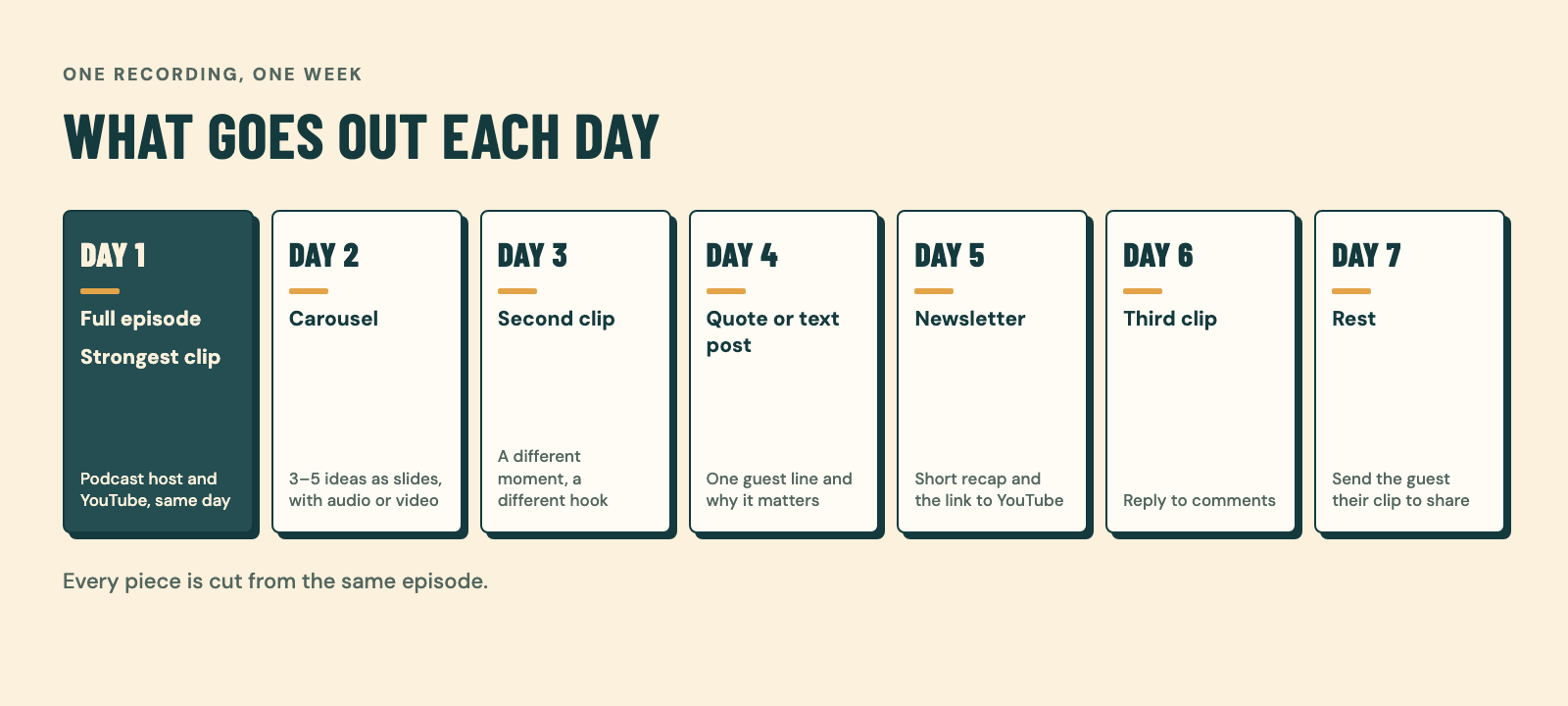
- Day 1: release the full episode. Publish it on your podcast host and upload the full video to YouTube the same day. In a 2026 Sounds Profitable study, YouTube accounted for 40% of favorite-show discovery among US podcast listeners. Your full episode needs to live there, not just your clips.
- Day 1: post your strongest clip. Pick the 30 to 60 seconds where something surprising gets said. Lead with that moment, not with “new episode.” Tag your guest and any company they mention.
- Day 2: post a carousel. Pull three to five ideas from the episode into slides. If you’re on Instagram, add audio or video so it has a chance in the Reels tab.
- Day 3: post a second clip. A different moment, a different hook. If the first clip was a story, make this one an opinion.
- Day 4: post a quote graphic or a text post. One line from the guest, with a sentence on why it matters. On LinkedIn this can be a plain text post with the clip in the comments.
- Day 5: send your newsletter. A short recap: what the episode covers, the one idea worth stealing, and a link to the full episode on YouTube.
- Days 6 and 7: post a third clip, then rest. Reply to comments and send the guest something easy to share, like the clip that features them.
Why spread it out? A clip posted on day four reminds people the episode exists, and each piece gets its own chance in the feed. Dumping everything on release day means the pieces compete with each other.
Tagging guests does more than it looks like. In one r/podcasting thread, a host said business guests they tagged were still driving downloads years later, because guests keep sharing an episode that makes them look good.
Consistency matters too. Another host, in the “no one will listen” thread, posted a short every day through October and gained about 300 YouTube followers. That’s not viral. It’s what steady posting from a back catalog looks like.
Which pieces pull their weight
The honest answer: it depends where your audience already is. If you’ve built a following on one platform, that platform will work hardest for you, whatever format you post there.
If you’re starting from zero, here’s my take. YouTube is hard to grow on from scratch, so don’t expect the full episode to find people by itself in the first months. The pieces that pull their weight are short clips and video carousels. It isn’t one or the other; you need both. In my experience, though, video carousels have done better than clips on views and engagement.
Here’s why carousels are worth a second look. A static carousel was a set of JPEGs or PNGs telling a small story. Carousels can now include video, and Instagram’s own creator blog says that “when you add audio to photos and carousels, they may also appear in the Reels tab” (Instagram for Creators, January 2025). With AI tools you can turn a static carousel into a short animated one, add music and sound effects, and post that in its place. The same slides now work for trust and for discovery.
On LinkedIn the format is different but the direction is the same. LinkedIn said in February 2025 that video uploads jumped by 36% compared to the year before, and it has been building a full-screen vertical video feed. For a B2B show, a captioned clip of your guest making one sharp point is the piece to post there.
Not everyone agrees on clips. One r/podcasting post argued that shorts “function more like advertising than a growth engine”, because the path from a short to a subscription has so many steps that very few people take it. That’s a fair point, and it’s the reason to keep the full episode on YouTube. Someone who likes your clip can watch the whole episode without leaving the app.
| Piece | What it does best | Where it fits |
|---|---|---|
| Full episode on YouTube | Keeps people who already liked a clip; gets found in search | Day 1 |
| Short clips | Reach strangers; show the guest at their best | Days 1, 3 and 6 |
| Video carousel | Discovery plus trust; several ideas in one post | Day 2 |
| Newsletter | Reaches people you already have | Day 5 |
Pick one or two platforms for podcast promotion, not six
A lot of podcast promotion advice comes with posting quotas no small team can hit. Podcast hosting company Castos, in a YouTube video on social promotion, suggests Instagram three or four times a day, LinkedIn once a day and TikTok four or five times a day. If you’re also running a business and recording the next episode, that plan dies by week three.
Spreading yourself thin across platforms was one of the most common complaints in the Reddit threads I read. Pick the one or two places your listeners already spend time and do the week there properly.
A quick way to choose:
- Your show is for business buyers (founders, marketers, operators): LinkedIn plus YouTube.
- Your show is for a consumer audience: Instagram plus YouTube, with TikTok if you already have a following there.
- You already have an email list: the newsletter is your most reliable channel, so never skip day five.
If you only have one hour a week, spend it before you record
This is where I disagree with most podcast marketing advice. The posting part is close to mechanical now. What most people miss is the planning before the recording, and that’s where I’d put the hour.
Clips can only be as good as the moments in the episode. If you’ve got bad input, you’re going to get bad output.
You can run a show as a structured conversation, an unstructured one, or something in between. I always lean toward semi-structured. You go in with a set of questions that are designed to produce clear, quotable answers, and you leave room for the conversation to go somewhere you didn’t plan.
Here’s how I’d spend the hour:
- Write five or six questions that each lead to one clear point (20 minutes). Ask yourself, for each one: could the answer stand alone as a 45-second clip?
- Send the questions to your guest ahead of time (10 minutes). Tell them you’ll use short moments as clips, so answers that start with the point and then explain it work best.
- Plan the one story you want them to tell (15 minutes). Every good guest has one. Ask about it by name.
- Note the moments you’ll clip (15 minutes, after the recording). Write the timestamps down while the conversation is fresh.
Get the questions right and prep the guest, and finding the clips afterwards is much easier. The clips also hold up better on their own, because each answer already makes sense without the rest of the episode. In a sense, you’re designing the episode around the clips. That’s the marketing, and it happens before anyone hits record.
What to measure
Skip follower counts as your main number. Watch three things instead:
- Average view duration on the full episode on YouTube. If people stay, the episode is doing its job.
- New subscribers or followers per week, on the one or two platforms you chose.
- Which clip sent people to the full episode. Check comments, profile visits, and traffic to the YouTube episode on the days after each clip.
Check these once a week, on the same day. After four or five episodes you’ll know which kind of moment your audience responds to, and you can plan the next recording around it.
Questions
How do I promote my podcast if I don’t have time?
Do the one-episode week on one platform only, and spend your planning time before the recording. Batch the posts for the week in one sitting and schedule them. One platform done well beats five done badly.
Are short clips worth it for a podcast?
Yes, if each clip is a moment that works on its own and the full episode is easy to reach from it. Clips work best as an introduction to the show, so keep the full episode on YouTube where viewers already are. Pair them with carousels rather than relying on clips alone.
Do paid ads work for small podcasts?
Sometimes, but they’re hard to track and can be expensive. In one r/podcasting thread, a host said podcast-app ads cost them about $12 per listener and that social ads did poorly. Most small shows get more from guest sharing and consistent clips first.
How do I get guests to share the episode?
Make it easy and make them look good. Send each guest the clip that features them, a ready-to-post caption, and the YouTube link on release day, and tag them in every post. Guests share an episode they’re proud of.
Start with the episode you already have
You don’t need a new podcast marketing strategy, more platforms, or a bigger team. You need one recording, a week’s plan, and the hour before you record spent well.
If you’d rather hand off the edit, the clips, the carousel and the posts for each episode, that’s what Videopod’s Episode Kit does.